
Hawaii Court Index vs Case File
Hawaii's public case search works as an index, not a full archive. It can identify a case. It can show public docket lines. It can also link to a document image you can buy. It does not put every filed Hawaii paper online. The official case file stays with the clerk. Certified copies are part of that file, held for the court and location named in the case.
These are different record products with different access paths. A free search helps you identify what to request. Buying a PDF or mailing a copy request is a separate step. When eCourt shows no PDF icon, the court may still hold a copy. It could be paper, offsite, or microfilm. Ask the clerk instead of assuming the item never existed.
| Record product | What it gives | Hawaii access path |
|---|---|---|
| Case index | Public case identity, selected status, event, and docket information. | Free search in eCourt Kōkua, subject to coverage and access rules. |
| Filed document | The actual order, motion, judgment, or other paper filed in the case. | Buy an eligible PDF through the portal or request it from the court clerk. |
| Certified copy | A clerk-authenticated copy for formal use. | Request from the clerk for the court that holds the file. |
How to Get Hawaii Court Records
There are several ways to inspect or request a Hawaii court record. The right route depends on the case's court, island or location, age, and access status. A county makes a handy geographic starting point. It is not a separate state-court record keeper, though. The county directory links to the relevant Judiciary area. The court and branch named in the case remain the final guide.
- Use the official Hawaii eCourt Kōkua entry page to locate a public case and note its case ID, court, and location. Hawaii index search is free; an eligible PDF image may be purchased separately.
- For in-person review, check the Hawaii Judiciary’s public-terminal locations and courthouse access instructions. Some terminals allow free viewing, while copies, staff searches, or retrieval work can cost extra.
- For a Hawaii paper or certified copy, identify the court and use its current written request form. The First Circuit’s form 1C-P-827 is not a universal statewide form; forms differ by circuit and record unit.
- Submit a written request in person or by postal mail where the branch allows it, or use the email or fax route listed for that office. Include the case number and, for a selected document, its filing date and title when known.
- Use Counties to find the Judiciary area, then check the court’s current records page or call the listed branch to confirm where the request belongs.
A phone call can confirm the right Hawaii clerk. It can also clarify the form, counter service, or archive path. The Judiciary publishes no single statewide phone-only copy process that covers every court record. If a record is older, confidential, or simply unclear, ask the branch first. Do this before you send payment or drive anywhere. Hawaii branches may use different forms or contact routes even for the same kind of court document.
Hawaii Court Record Requests by Location
Hawaii's Legal Documents Branches belong to the State Judiciary. The statewide request page lists circuit contacts and current forms. But the filing court decides which branch can actually find the record. The First Circuit serves Oʻahu. The Second covers Maui, Molokaʻi, and Lānaʻi. The Third serves Hawaiʻi Island through Hilo and Kona locations, while the Fifth handles Kauaʻi. So five county directory links do not map neatly onto four active circuits.
The Judiciary's court records request directory lays out the circuit-by-circuit Legal Documents Branch routes. It also provides each local request form.
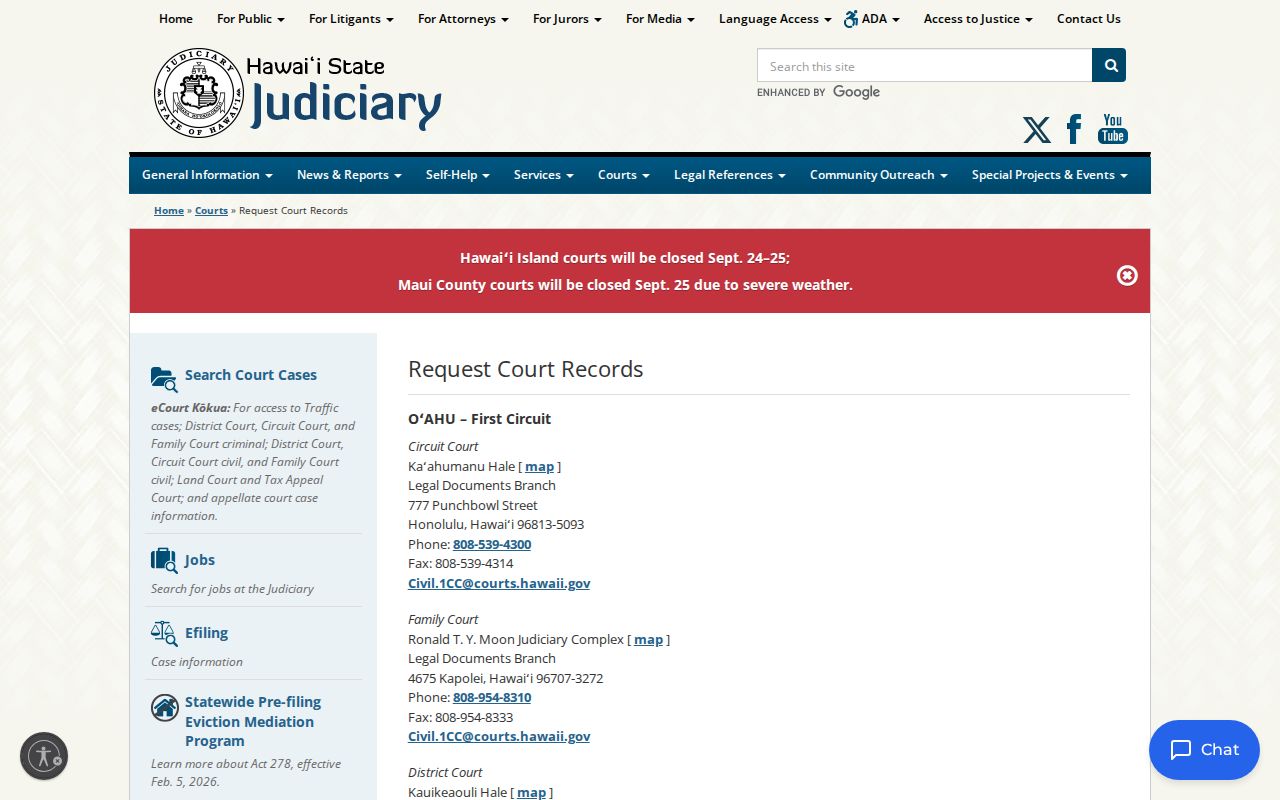
The directory also splits record units within circuits. It separates some civil, criminal, Family Court, District Court, and traffic requests. Pick a branch using the court and location on the case. Your home county does not control the choice. Kalawao is not proof of a separate Hawaii courthouse or portal. When a county route leaves the filing court unclear, use the case ID. The court location or the Judiciary contact directory can also confirm which records office is responsible.
Types of Court Records
A Hawaii court record can include the docket or minutes. It may also hold pleadings and motions, filed orders, judgments, exhibits, and other papers in the case file. The docket shows only that a document or action was entered. It does not give the full text of every filing. When a public docket line carries a PDF icon, eCourt may sell that document image for a separate charge. A missing icon can mean the document is not online. Even then, a clerk may hold a copy.
Some case records also list scheduled events, party details, and related-case links. Audio, video, and transcripts are separate products with their own request steps. A traffic abstract is the court's compiled traffic record, not a docket. A driver-history record sits with the transportation agency rather than the court. Name the exact product so the clerk can find the right record.
Hawaii Court Records Fee Scope
Index searches and document copies in Hawaii do not share one price. The Hawaii eCourt Kōkua manual sets the online charge for a PDF offered through the portal. Paper copies, certification, exemplification, staff searches, microfilm, and retrieval rates vary. They depend on the particular court and its current schedule. Never quote one circuit's fee as the rate for every Hawaii clerk.
The First Circuit fee sheet shows how a copy total can shift. Page count, certification, and retrieval work all play a part. It also gives a written-request invoice preparation window. That window is not a guaranteed completion or delivery date. Check the current schedule for the court holding the record. Do that before quoting any total. A Hawaii fee table needs its court and source stated. Circuit and specialized-court forms can differ.
What a Court Record Contains
A Hawaii case screen tells you the case name. It shows the court and its activity too. Related data sits under separate tabs. One tab does not hold everything. A public docket line may point to a filed image. The index and the file itself are different things. These Hawaii fields help you tell what is on screen and what still takes a clerk request.
| Case description | Hawaii case ID, case type, status, last updated date, filing date, court, and location. |
|---|---|
| Party list | Names and aliases in a Hawaii case, party ID, party type, sequence, association, and end date where listed. |
| Docket and minutes | Entries describing Hawaii filings and court actions. Sealed items or filings reviewed privately by a judge can be masked. |
| Events | Future and completed settings, with an appearance disposition when available. |
| Filed documents | Actual Hawaii papers such as a motion, notice, order, or judgment; a PDF icon indicates an image may be purchased online. |
| Other case detail | Related-case links or bail/bond information may appear. Criminal cases can have an Offenses tab; civil cases do not. |
Think of the Hawaii docket as a map. It leads you through the case file. The docket tracks what was filed and when. For legal effect, though, read the filed order or judgment itself. A status label or calendar entry is only a pointer, not the ruling.
Hawaii Court Records Under HCRR
The Hawaiʻi Court Records Rules (HCRR) decide which Hawaii court records are open. They also set the process for inspection and copying. Rule 4 defines a court record. It lists Hawaii filings, orders, exhibits, dockets, minutes, and data in the case-management system. Rule 5 handles access limits. Rule 9 deals with personal identifiers and account numbers. Rule 10 governs Hawaii access requests. Going electronic never enlarges your right to view a confidential record.
The Hawaii Judiciary’s Rules of Court index shows the current record rules. Amendment orders and related forms appear on its official page.
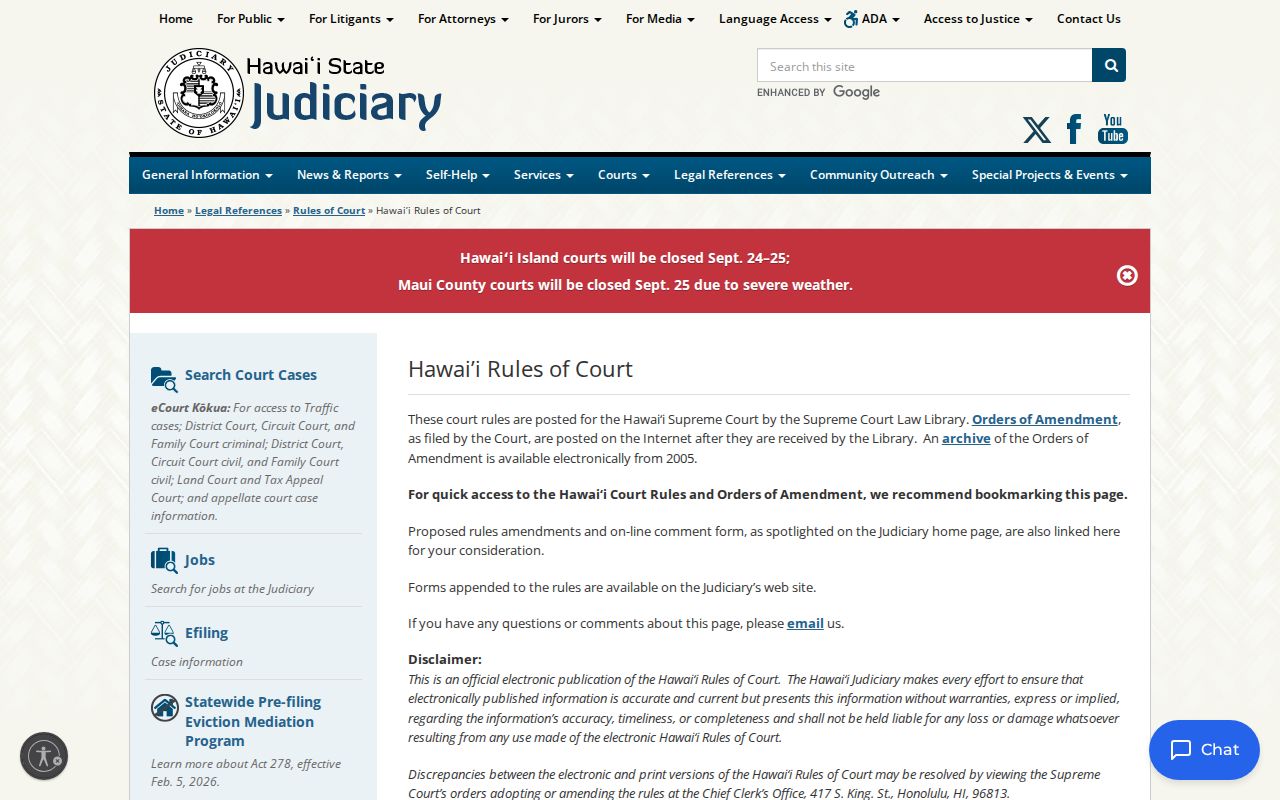
Start with the official Hawaii rule index. It holds the current text and amendments. Rule 10.17 routes bulk or compiled record requests to the Administrative Director. The Director reviews them. The review carries reasonable charges. That rule is not permission to automate Hawaii portal extraction. Redaction duties under Rule 9 sit with the person filing the document. The Hawaii Judiciary says eCourt blocks designated fields for some personal identifiers. Still, users should not assume every private detail is gone from a public filing. Note: Hawaii access rules do not create online images for every document. Some court case file papers stay offline.
Certified Copies and Fees
A certified Hawaii copy comes from one place. It comes from the clerk of the court file. That is the only route. A public eCourt result is not a certified record. Buying a PDF online is not the same as a clerk-authenticated paper copy. The rates listed keep things straight. They separate the statewide Hawaii portal price from charges documented for the First Circuit.
| Record or service | Documented charge | Scope and note |
|---|---|---|
| Standard eCourt document | $3 per document up to 30 pages, or $0.10 per page above 30, whichever is greater. | Current public manual; applies to an eligible online PDF. |
| Electronic certification | +$2 per document. | Added to the standard eCourt copy charge; online transactions are non-refundable. |
| Paper copy | $1 first page; $0.50 each additional page. | First Circuit fee schedule only. |
| Certification | $2 per document. | First Circuit fee schedule only. |
| Exemplification | $4 per document. | First Circuit fee schedule only; a special authentication format, requested when applicable rules require it. |
| Name search by clerk | $5 per name. | First Circuit schedule; ordinary search range is 1984 to present unless otherwise specified. |
Don't read the First Circuit amounts as a universal Hawaii fee table. Other Hawaii circuits and specialized courts publish their own request forms or instructions. Retrieval or expedited work can add charges too. The First Circuit’s form 1C-P-856 fee schedule says an invoice for a written request is prepared within five business days. That timeline covers billing, not completion of the copy itself.
UIPA and Hawaii Court Records
Hawaii’s Uniform Information Practices Act (UIPA) sets the state open-records rules for government records. It is Chapter 92F of the Hawaiʻi Revised Statutes (HRS). It applies subject to exceptions. HRS §92F-3 leaves Hawaii courts’ nonadministrative functions outside the UIPA definition of a government agency. Meanwhile §92F-11 generally requires government records to be available. That broad agency process cannot replace the Hawaii court-specific access rules. Those rules govern a filed case record.
The Hawaii Office of Information Practices explains the UIPA framework. It can reach administrative records held by Judiciary offices. It does not put a Hawaii court clerk’s case file under an agency response deadline. For a docket, filing, or certified copy, use HCRR and the correct court branch.
Public Access and Sealed Records
Hawaii court records are generally open unless a statute, rule, or court order says otherwise. Even a public Hawaii case can carry masked docket lines or restricted documents. Juvenile proceedings, adoption, child-protection matters, and some Family Court records get extra confidentiality protection. Other Family Court matters may be public. Check the record’s category. Check the rule too. Do that before assuming any Hawaii family case is open or closed.
Hawaii access rules: Hawaiʻi Court Records Rules 5, 9, and 10 address Hawaii access restrictions, protection of personal information, and inspection or copy requests. HRS §571-84 protects juvenile proceedings and records; adoption and child-protection records have additional statutory limits.
For a sealed Hawaii item or a case absent from public search, ask the clerk about the lawful access route. A paid copy request cannot lift a Hawaii seal.
A missing online Hawaii item has several possible causes. It may sit behind a legal restriction. It may live in an older paper or microfilm file, or simply not be offered for online purchase. The Hawaii State Judiciary clerk can confirm the record’s status. The clerk can also say whether a court order or other authorization is required.