
The Hawaii Court System
Hawaii has one state Judiciary rather than county court systems. District Court handles limited-jurisdiction trials. The District Courts hear traffic, many misdemeanors, and civil matters within their limits. Circuit Court takes general-jurisdiction work, including felonies, jury trials, probate, and higher-value civil cases. A felony can start in District Court. It can later move to Circuit Court. So a single Hawaii case may touch both court levels.
Family Court sits as a division of Circuit Court. Land Court and Tax Appeal Court cover specialized statewide matters. Environmental Court is a Circuit Court specialization. Trial records stay with the Circuit and District Courts. The Hawaii Supreme Court and Intermediate Court of Appeals keep their own appellate dockets. The court, case type, and location on a record tell you where to look.
Hawaii state court dockets stay separate from federal cases filed in the same islands. The official PACER Case Locator routes federal searches. The nonprofit CourtListener/RECAP collection may offer free copies of some filings. But its coverage is incomplete. An absent copy does not mean a federal document was never filed.
| Hawaii Court | Main Role | Public Docket Route |
|---|---|---|
| District Court | Traffic, many misdemeanors, and civil cases within its limits. | eCourt Kōkua; District Legal Documents Branch or Traffic Violations Bureau. |
| Circuit Court | Felonies, jury trials, probate, and higher-value civil matters. | eCourt Kōkua; Circuit Legal Documents Branch. |
| Family Court | Family and juvenile matters within the Circuit Court division. | eCourt for public matters; restrictions may apply. |
| Land and Tax Appeal Courts | Statewide land registration and tax matters. | eCourt where available; court clerk for older files. |
| Environmental Court | Qualifying environmental matters on a Circuit Court docket. | Search the underlying Circuit case. |
| ICA and Supreme Court | Intermediate and final state appeals. | eCourt appellate search and opinions/orders. |
The Hawaii Supreme Court sits at the top and sets the rules. Every appeal gets its own case number, filings, events, and orders, even when the trial docket shows a notice of appeal. For published decisions, the Judiciary’s opinions and orders page links to Hawaii Supreme Court and ICA rulings.
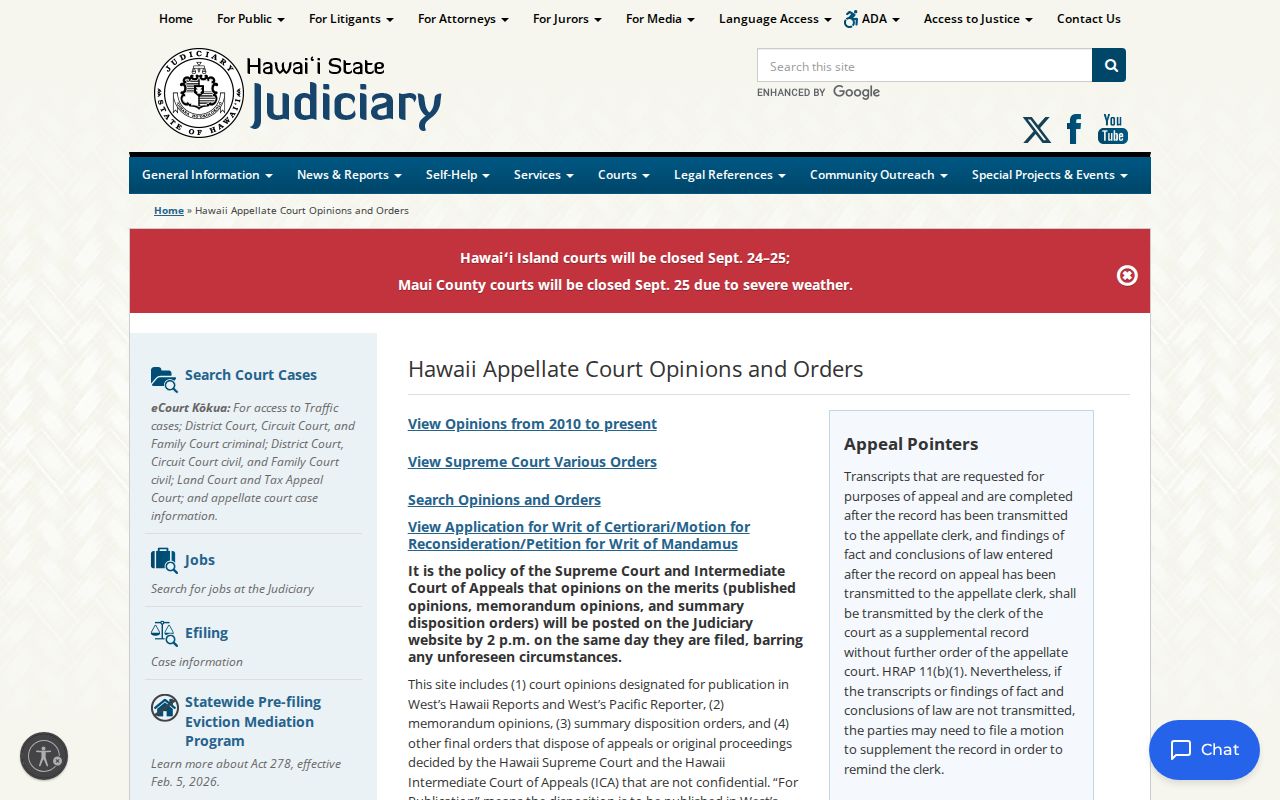
Those published opinions supplement rather than replace the appellate docket for a specific case, and they say nothing about the trial record beneath them.
Hawaii Court Circuit Map
Hawaii has four active numbered circuits: First, Second, Third, and Fifth. The old Fourth Circuit merged into the Third in 1943. The gap is history, not a missing Hawaii court. Circuit numbers also show up inside JIMS and JEFS identifiers. The Second Circuit spans more than one island. That is one more reason a county folder is not a court map.
Match the circuit prefix, court name, and location printed on the case or citation. Those details can be unclear at times. The Judiciary’s Hawaii court locations directory then points to the right record office.
This Hawaii court map lays out the Judiciary’s statewide location network.
Four circuits, one Judiciary. That structure is why a statewide docket search leans on court and location filters rather than a county court database.
Note: A county directory helps with local court contacts, but the case’s circuit and court location govern the record request.
The Statewide Case Search Portal
eCourt Kōkua is the Hawaii Judiciary’s public case-information portal. It searches Traffic, District, Circuit, Family, Land, Tax Appeal, ICA, and Supreme Court categories. It covers four circuits. You can search by party, vehicle, case, filing date, or upcoming hearings. Court, location, and island filters identify the Hawaii filing court. It is not a set of county-run docket sites.
Hawaii case search costs nothing. Results may include summaries, parties, events, docket entries, minutes, and PDFs where offered. An icon marks an online copy. No icon does not mean the court lacks the document. Begin at the official eCourt Kōkua page, because a direct application address may redirect.
| Portal Layer | Hawaii Coverage | Limit to Keep in Mind |
|---|---|---|
| Hawaii case classes | Traffic, trial, specialized, and appellate courts. | Sealed or restricted matters may be masked. |
| Search paths | Party, vehicle, case, date, and hearing. | Dropdowns depend on earlier choices. |
| Case detail | Summary, parties, events, docket/minutes, and offenses. | A result is not the full case file. |
| Documents | Some public PDFs are available for purchase. | No icon does not prove no filing exists. |
Missing record? Ask the clerk about the case type and the item you need. eCourt reflects public JIMS data, not the filing system or the clerk’s own records. The holding court controls the official docket, older paper files, and certified copies.
Hawaii Court Search Limits
A blank Hawaii case result proves nothing. The case may be new, restricted, outside the online date range, or indexed under a different name. Sealed and in-camera lines can be masked from view. When a search does not settle the question, ask the Hawaii court clerk.
Case-information dates and document-image dates also differ. A Hawaii summary may appear online while older papers remain offline in paper or microfilm at the court.
| Case information | Traffic before November 1995; District criminal before August 2012; appellate before September 2010. |
|---|---|
| Older documents | District civil before Oct. 7, 2019; Circuit civil before Oct. 28, 2019; Land/Tax before Nov. 18, 2019; Family civil before Apr. 25, 2022. |
| Other causes | Privacy rules, name variation, new intake, or no online PDF. |
| Follow-up | Ask the clerk for the court that holds the Hawaii case. |
Index and record differ: Hawaii’s portal can list a case while older or restricted papers remain subject to court access rules.
Note: A missing document icon describes online availability, not whether the Hawaii court received or kept a filing.
How Dockets Flow From County to State
A Hawaii filing begins at the court with jurisdiction. The clerk or an authorized filing route adds it to the case record; JIMS maintains case data, while JEFS sends covered filings and service. eCourt Kōkua then displays the public information that access rules allow.
Hawaii docket flow: Court filing → Clerk record → JIMS case data → eCourt Kōkua public index
The Hawaii court clerk keeps the official file. It may be paper or electronic, with its filings and minutes. An online event can update before its document image does. Use the Hawaii county directory to find Judiciary contacts, then match the case’s court and location.
Note: County routes help you locate the right Judiciary office. They do not lead to five separate case-management databases.
Hawaii Court Record Custodians
Hawaii's courts put out records in several forms, and the pieces are not the same thing. A docket entry open to the public, an e-filing, and the data a clerk sees on screen can all touch one case yet answer different questions.
- eCourt Kōkua
- The public-facing Hawaii case search, upcoming-hearing, and document-purchase service.
- JIMS
- The Judiciary Information Management System, which maintains case-management data, events, docket entries, and identifiers.
- JEFS
- The Hawaii Electronic Filing and Service System for registered attorneys and parties in covered cases.
- Legal Documents Branch
- The court-level record office for requests, copies, and case-specific questions; it is not a county clerk database.
The Administrative Offices of the Courts handles Hawaii-wide administration, technology, statistics, and operations. It does not take the place of the case clerk, so a docket question still goes to the Hawaii court holding the record.
JEFS and E-Filing
JEFS is the Judiciary's electronic filing and service system for attorneys and parties who register. Coverage is broad. The Supreme Court and ICA, major Circuit, District, and Family Court categories are covered, plus Land and Tax Appeal Court. Public state-court categories opened statewide by April 2022, though case rules and exceptions still vary. Civil traffic and administrative license-revocation matters get special treatment. The Judiciary's JEFS access guidance lists which courts are covered and how to register.
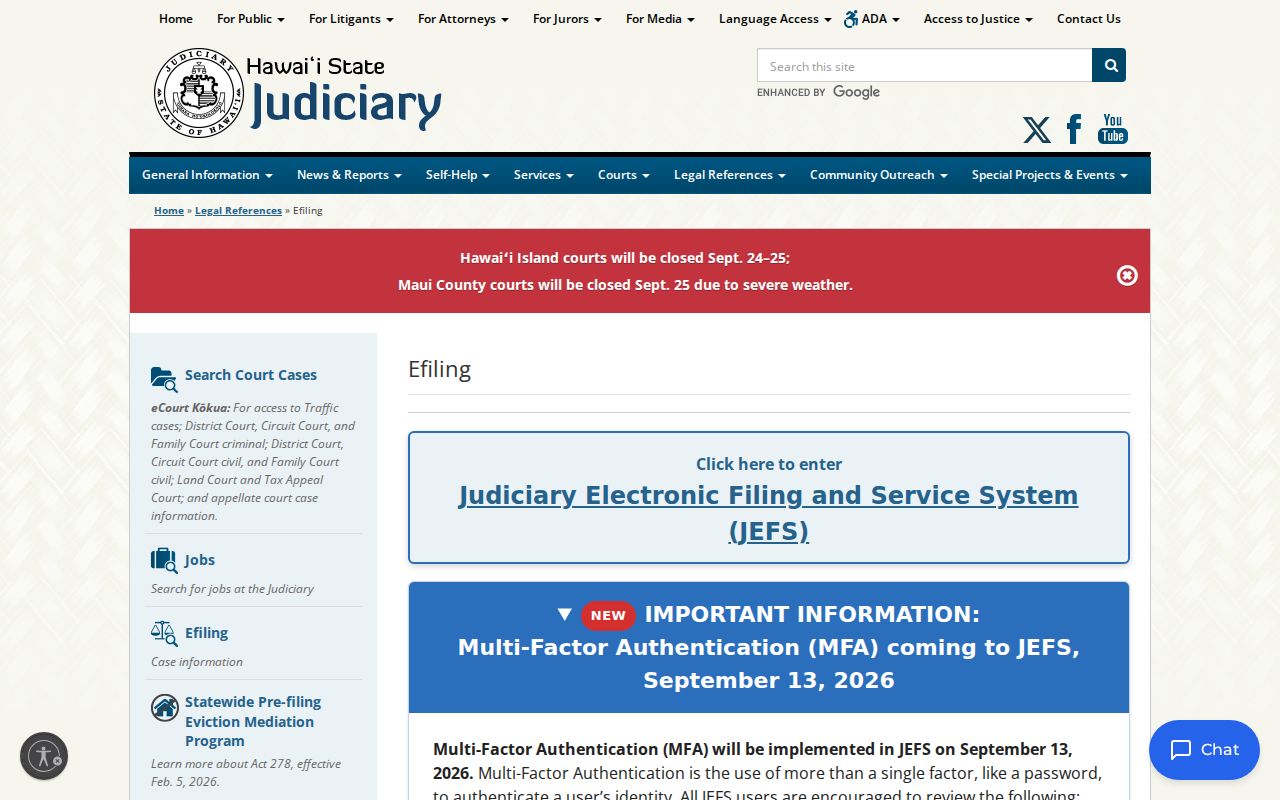
JEFS exists for enrolled filers. Members of the public search a Hawaii case through eCourt instead of signing in to file anything. The JEFS sign-in screen is part of the participant workflow.
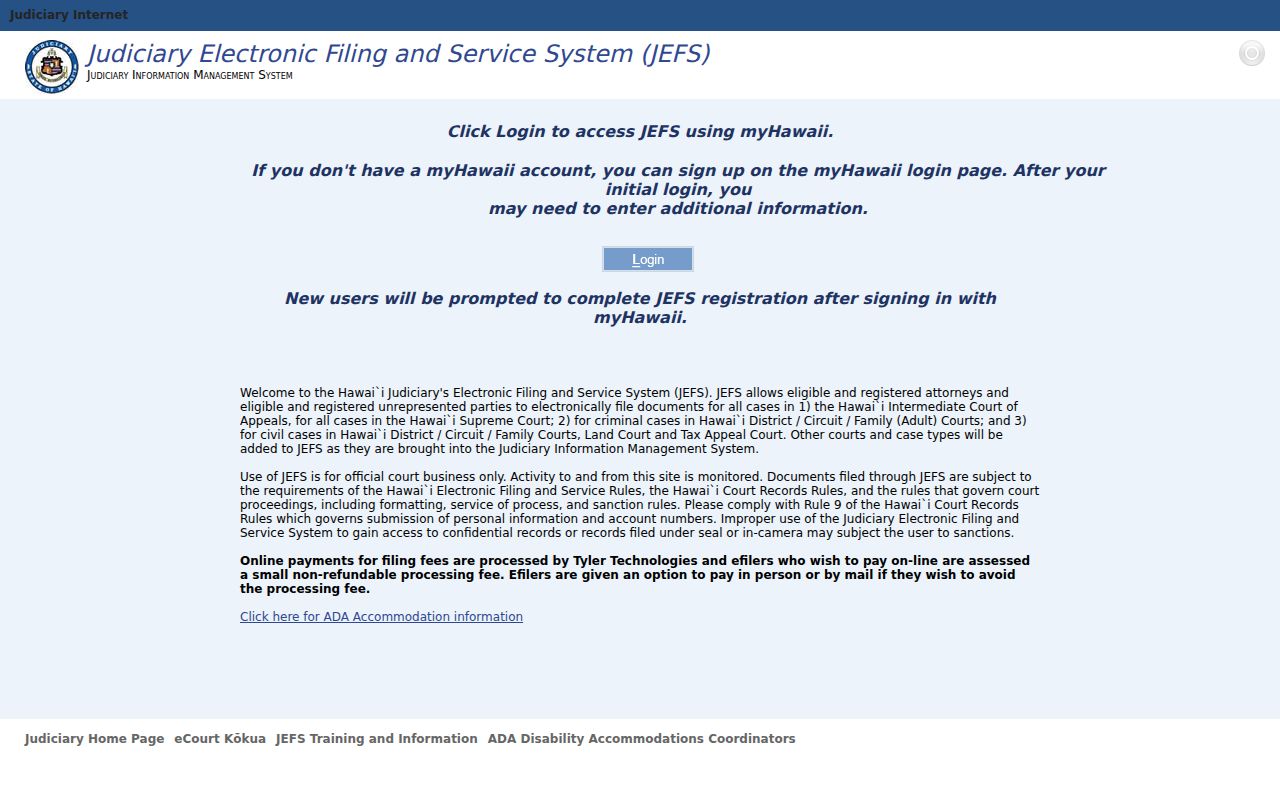
A filing login is not a public search tool. What you can reach depends on account status, court rules, and case type, and public visibility follows the court-record rules.
Hawaii Court Filing Timing
A new Hawaii document may not appear right away. It can take up to three business days to show up in eCourt Kōkua. Traffic citation intake runs on its own delay. So an empty docket result is no excuse to skip a notice or response deadline. JEFS queues can also slow near midnight. A technical receipt does not decide whether a filing meets the court's rule or deadline. Keep the confirmation, and ask the receiving Hawaii court clerk if the docket stays incomplete. Online display timing, filing acceptance, and the legal effect of a submission are separate questions. The applicable court process decides each one.
Statewide Portal vs County Docket
eCourt Kōkua is a statewide index of Hawaii cases. The clerk of the holding court keeps the rest: the full docket, documents, older paper or microfilm items, and certified copies. Each tool serves a different step in a record search.
| Question | Statewide eCourt Kōkua | Court Clerk Record |
|---|---|---|
| Role | Public view of permitted JIMS information. | Official paper or electronic file. |
| Reach | Listed public cases across four Hawaii circuits. | Case held by that court. |
| Documents | PDFs only when available online. | Clerk handles copy requests. |
| Certification | Search result is not certified. | Ask the court clerk. |
The index can find an event. The filed Hawaii order tells you what the court actually directed. Open the PDF when one is offered, or call the Hawaii court clerk. The Hawaii county directory links to local Judiciary contacts. Follow the court and location listed in the case.
Hawaii Court Administration and Caseload
The Hawaii Administrative Offices of the Courts backs statewide technology, administration, and statistics. It does not search an individual docket. The Judiciary's AOC contact page is for system questions. Case questions go to the Hawaii court clerk. The FY 2024-25 Judiciary caseload report counts 367,145 District Court filings. It also records 16,779 Circuit Courts Proper filings. It further lists 836 primary appellate filings, tracked separately from supplementary proceedings. These are report categories, not a tally of every Hawaii filing or of people. A one-year filing count is a flow measure. Never combine it with pending-case totals or call it active cases.
Hawaii Court Technology and History
Hawaii's public docket tools have shifted over the years. HoʻoHiki launched in 2000. eCourt Kōkua replaced CourtConnect in 2010. A 2016 refresh modernized HoʻoHiki before it retired in 2022. Public case categories then moved into JIMS and JEFS. The Judiciary added an Upcoming Court Hearings search in 2023. It refreshed eCourt's layout in May 2026. Older Hawaii case numbers may look different from newer JIMS formats. Some pre-cutoff documents need a clerk search. Use the current Judiciary portal rather than instructions for retired systems. The official eCourt launch notice and HoʻoHiki history record two of those transitions.
Hawaii Court Programs and Public Dockets
Hawaii specialty courts are programs inside the Judiciary, not standalone county portals. In 2026 the Judiciary marked thirty years of Drug Court. It reported 2,714 graduates statewide through May. That figure is a program milestone. It is not an annual filing count or a case-search result. The Hawaii Judiciary's Drug Court anniversary release describes its expansion. It covers all four active Hawaii circuits.
The program sits inside the statewide court structure. A participant's own matter still follows the rules for its court and case type, including any privacy limits. Public program totals say nothing about a person's case history.