
Traffic Court Records in Hawaii
Every Hawaii traffic infraction lands in District Court's traffic division. It can also go to the Traffic Violations Bureau for the circuit where the alleged violation happened. There is no municipal or justice-of-the-peace tier handling these traffic dockets. A traffic offense charged as a crime runs under criminal procedure instead. District or Circuit Court handles it, depending on the charge. The Hawaii court docket shows the citation, each event, the response, the disposition, and any filings. Match the court and location printed on your citation. Then use the Hawaii county directory for Judiciary contacts. The driver history is a different file kept elsewhere.
Hawaii Traffic Court Tiers
District Court takes Hawaii traffic infractions. Traffic Violations Bureau work is tied to the circuit on the citation. A charge filed as a crime follows a criminal docket instead. The court and case-type fields on a record tell you which Hawaii route applies. County destinations point to Judiciary contacts, not separate county traffic databases. For follow-up on the court named in the notice, the Hawaii court locations directory and Hawaiʻi Civil Traffic Rules are the useful stops. Start with the location page. The rules come next for procedure.
- Traffic infraction
- A civil traffic matter handled under the state traffic rules and the court named on the citation.
- Traffic Violations Bureau
- The District Court traffic unit that handles traffic matters in the relevant circuit.
- Traffic crime
- A criminal case whose court and stage depend on the charge and procedural history.
Statewide Citation and License-Hold Systems
Hawaii offers a public case portal, a payment route for eligible tickets, and a separate office for driver records. License-stopper guidance is not a searchable hold database. Turn to the case portal for court information and to the citation notice for payment or response steps.
| System | What It Holds | Run By |
|---|---|---|
| eCourt Kōkua | Public traffic case information; case search can accept a citation number, and Vehicle Search can use plate or VIN. | Hawaii State Judiciary |
| eTraffic Hawaiʻi | Payment lookup for eligible citations already entered in the court system; not every ticket can be paid online. | Official Judiciary payment route |
| License-stopper guidance | Information about certain failures to answer, appear, or comply; no public statewide stopper search was located. | Hawaii State Judiciary |
| Driver History Record | State driver history, including reported violations and license status; not the traffic court docket. | Hawaii Department of Transportation |
Hawaii case search is free, though copies may cost extra. Certified traffic abstracts and court reports come from the Traffic Violations Bureau, not the driver-record office. Note: eCourt Kōkua, eTraffic Hawaiʻi, and the HDOT Driver History Record each answer a different question and draw on different records.
Hawaii Traffic Search Fields
In eCourt Kōkua, look up an indexed Hawaii citation by case ID or citation number. Vehicle Search works from a license plate or VIN if needed. Remember, these are court case searches, not driver-history lookups, and the live dropdowns can change.
| Case Search | Case ID is the usual required value; citation number is an alternate identifier where indexed. Filing dates and other case identifiers may also appear. |
|---|---|
| Plate Search | Enter the license plate number. State, filing dates, and case type are optional filters when shown. |
| VIN Search | Enter the VIN; date range and case type can narrow results when those fields appear. |
| eTraffic Payment | Use the citation and vehicle information requested by the official payment screen. Eligibility and required fields can vary. |
The manual does not spell out every dropdown value, so never guess the Hawaii court or case type. The Hawaii case search steps walk through the broader lookup. Check the Hawaii court, location, title, filing date, and status against the citation.
How to Look Up a Hawaii Traffic Ticket
Your citation names the Hawaii court and the response route, so start there. Search for an indexed case, then lean on the notice for deadlines and allowed options. A brand-new ticket may simply not appear yet.
- Read the citation for the court, circuit, citation number, response date, and any required appearance.
- Search eCourt Kōkua by case ID or citation number. For a traffic case without either, try Vehicle Search by plate or VIN.
- If the case is missing, follow the notice’s response method or contact the listed court. Use the county directory to locate Judiciary court contacts.
- Check the case events and filed notice for the date, time, location, and whether an appearance is required.
The Hawaii court calendar can help you find an event. But the filed Hawaii notice or order controls.
The Judiciary's Upcoming Court Hearings search shows a two-week calendar view for Hawaii courts. Search by case ID or by court and location. Then narrow things down by date, time, or courtroom and division. A result lists the event, date, time, and appearance disposition on a Hawaii docket. Schedules shift, so the filed notice still governs. When a Hawaii hearing does not show up, it may be restricted, newly entered, or outside the search window. Some events simply fall outside the window.
When a Hawaii Traffic Ticket Is Missing
Give it time first. A Hawaii ticket can take 13 days or longer to reach JIMS. Traffic records before November 1995 fall outside eCourt's online range. A blank result never replaces the response directions on the citation.
The Hawaii Judiciary's moving-citation page says 21 days from issue; eTraffic guidance says 21 days after receipt. Those are two different clocks, so do not merge them. Follow the notice. Call its court if unsure.
Note: Online absence can reflect intake timing, an older Hawaii record, or restricted access.
Hawaii Traffic Docket Terms
Hawaii traffic screens rely on short event and disposition codes. The Judiciary's traffic glossary fits traffic cases, not every court docket. Read a code beside its status, entry, and any linked order.
- AP
- Arraignment and Plea, an event abbreviation in the traffic-code glossary.
- FTA
- Failed to Appear, a recorded event or status that does not by itself explain a later order.
- DJ
- Default Judgment, a traffic-case action or disposition code.
- DAG / DNC
- Defer Acceptance of Guilty Plea / Defer Acceptance of No Contest Plea.
ACTIVE means action is still pending. CLOSEDJ means court action ended in dismissal or judgment, though obligations can survive. CLOSEDS means the judgment is fully satisfied. Treat a short code as a pointer, never a full account of its legal effect.
Paying or Contesting a Ticket in Hawaii
An eligible Hawaii citation can be paid through a channel the Judiciary lists. The notice may list others. Deny it, and you can request a hearing or, where allowed, send a written statement. Some tickets require an appearance no matter what. The Hawaii citation and the Hawaiʻi Civil Traffic Rules govern.
| Pay an Eligible Citation | Contest the Citation |
|---|---|
| Use eTraffic, phone, mail, or in-person payment only when the notice and court allow it. | Enter a not-guilty response and follow the notice for a hearing or written statement, if permitted. |
| Payment resolves the citation through the court’s process and may be recorded as an admission. | The court sets or reviews the matter; a hearing or written decision follows the applicable procedure. |
| Online payment is limited to eligible citations already entered in the system. | A required appearance cannot be replaced by an online payment. |
The Judiciary's eTraffic Hawaiʻi payment information explains which tickets qualify and sets out Hawaii's official payment route.
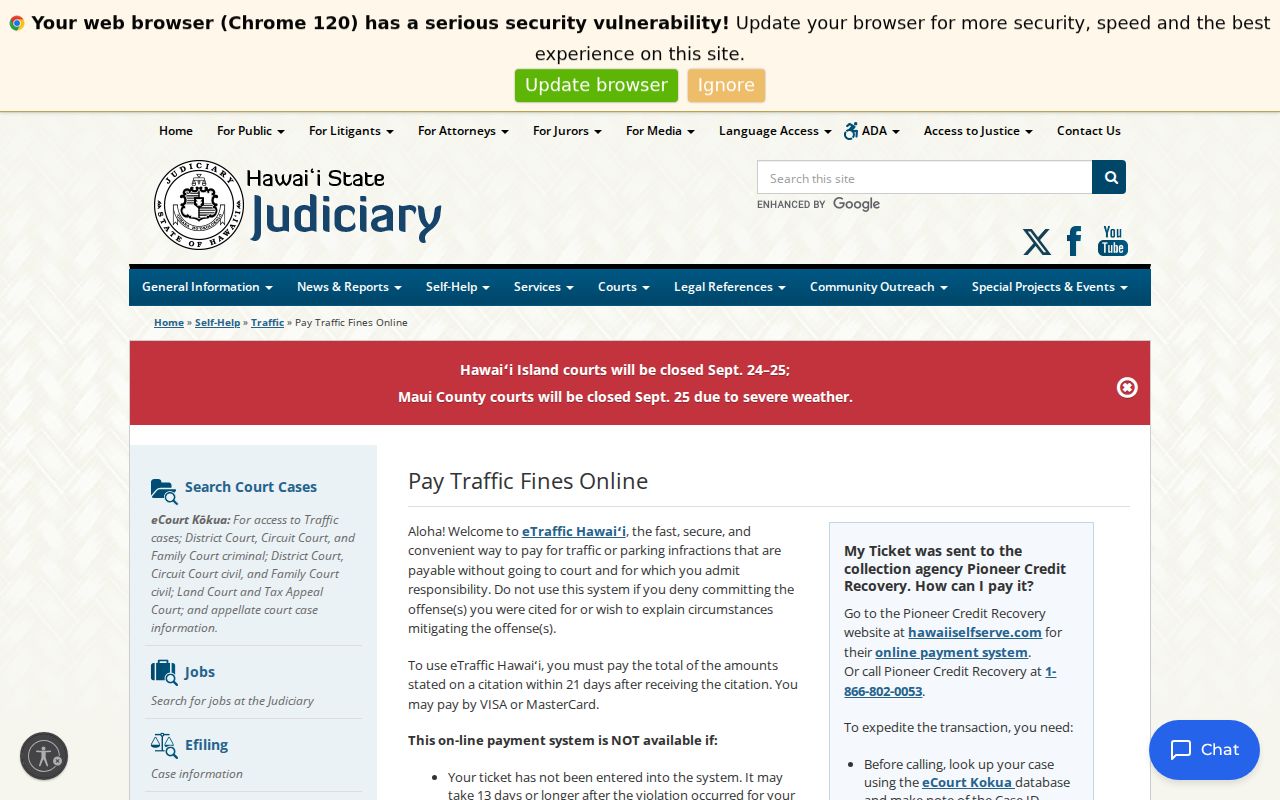
Pay online only after confirming the citation is eligible and already entered. An online lookup does not change a response deadline.
Missed response or court date: A court may enter a default judgment when an answer is not filed within the allowed period. Older Judiciary help text describes a license stopper after default nonpayment, but current HRS §291D-12(b) bars withholding a license or registration solely for unpaid Chapter 291D assessments. A missed required response or appearance is a separate issue; check the current order and ask the issuing court about the case.
Note: The citation's stated response route still matters when the online payment option is unavailable.
Hawaii Traffic License-Hold Conflict
Older Hawaii Judiciary guidance talked about a "stopper" after certain failures to answer, appear, or comply. The law has moved since then. Current HRS §291D-12(b) says the State cannot withhold a driver's license or registration over unpaid Chapter 291D items. Nonpayment of an assessment, community service, or State judgment alone is not enough.
That statute does not fix every problem tied to a missed court date or court order. Read the most recent Hawaii order in the case. Then ask the issuing District Court or Traffic Violations Bureau directly. The Judiciary's stopper page lays out relief procedures for some defaults. Its older nonpayment text has to be read alongside current law.
The Judiciary's published guidance spells out the procedures that can follow a missed response or missed appearance in traffic court.
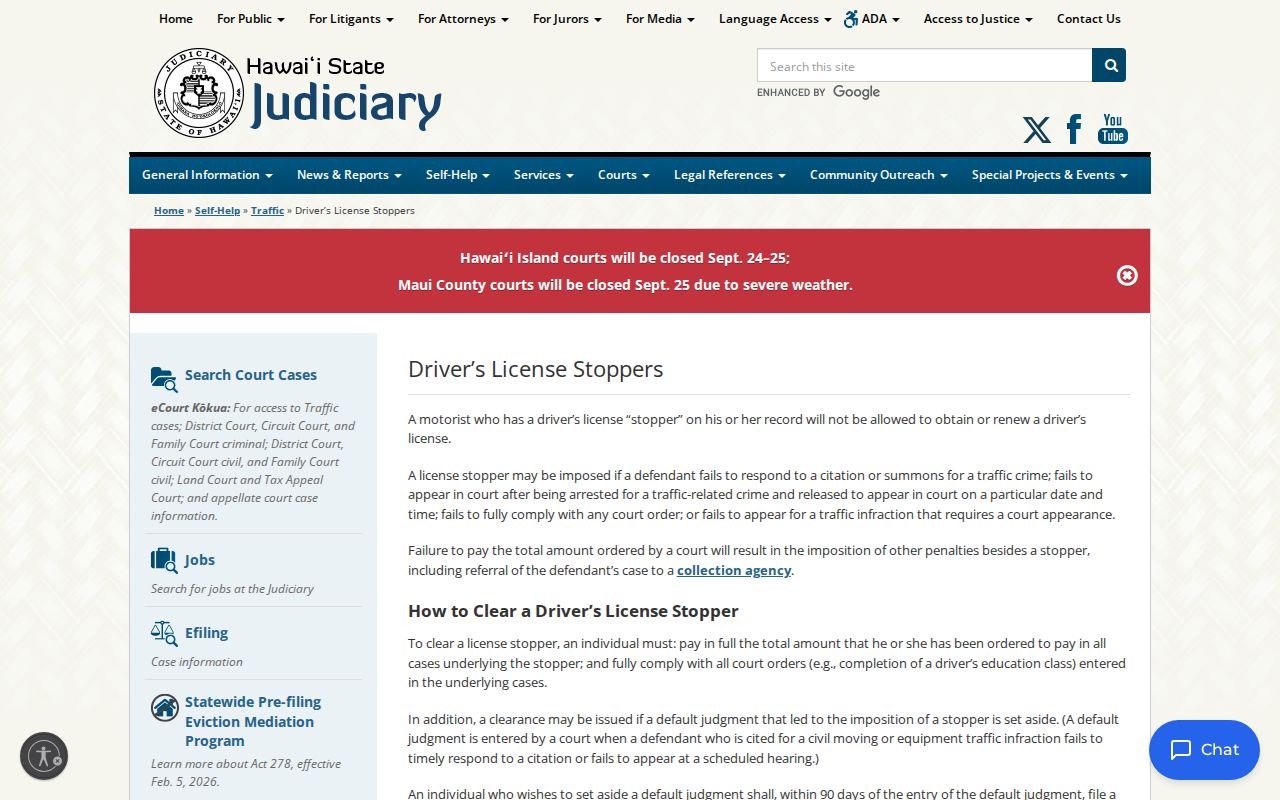
This is procedural information about court docket practice, not a public list of who has a hold. Questions about a specific traffic case go to the court named on the citation.
Hawaii Older Traffic Docket Codes
Hawaii traffic records from 1995 through 2005 may carry TRAVIS labels. TRAVIS is a holdover from the Judiciary’s former system. That system was migrated into JIMS. So an older eCourt docket entry can still show a legacy event, disposition, minute, bond, or payment code.
Traffic case information predating November 1995 sits outside eCourt’s range. An old Hawaii case number may not come up in a docket search. Ask the clerk to convert it. TRAVIS is a history label, not a portal you can search today.
Court Traffic Record vs Driver Record
A Hawaii traffic docket and a Driver History Record are two different files. The court docket covers citations, hearings, orders, and the case disposition. HDOT’s Motor Vehicle Safety Office keeps the Driver History Record, which tracks license status, reported violations, crashes, and suspensions instead.
| Record | Court Traffic Case | Driver History Record |
|---|---|---|
| Custodian | District Court or Traffic Violations Bureau. | Hawaii DOT Motor Vehicle Safety Office. |
| Shows | Citation, docket, events, disposition, filed documents. | License status, violations, crashes, suspensions. |
| Request route | eCourt for public case info; ask court for an abstract or certified copy. | HDOT self-request: $9 and acceptable identification. |
The HDOT Driver History Record request page identifies the state custodian and request process.
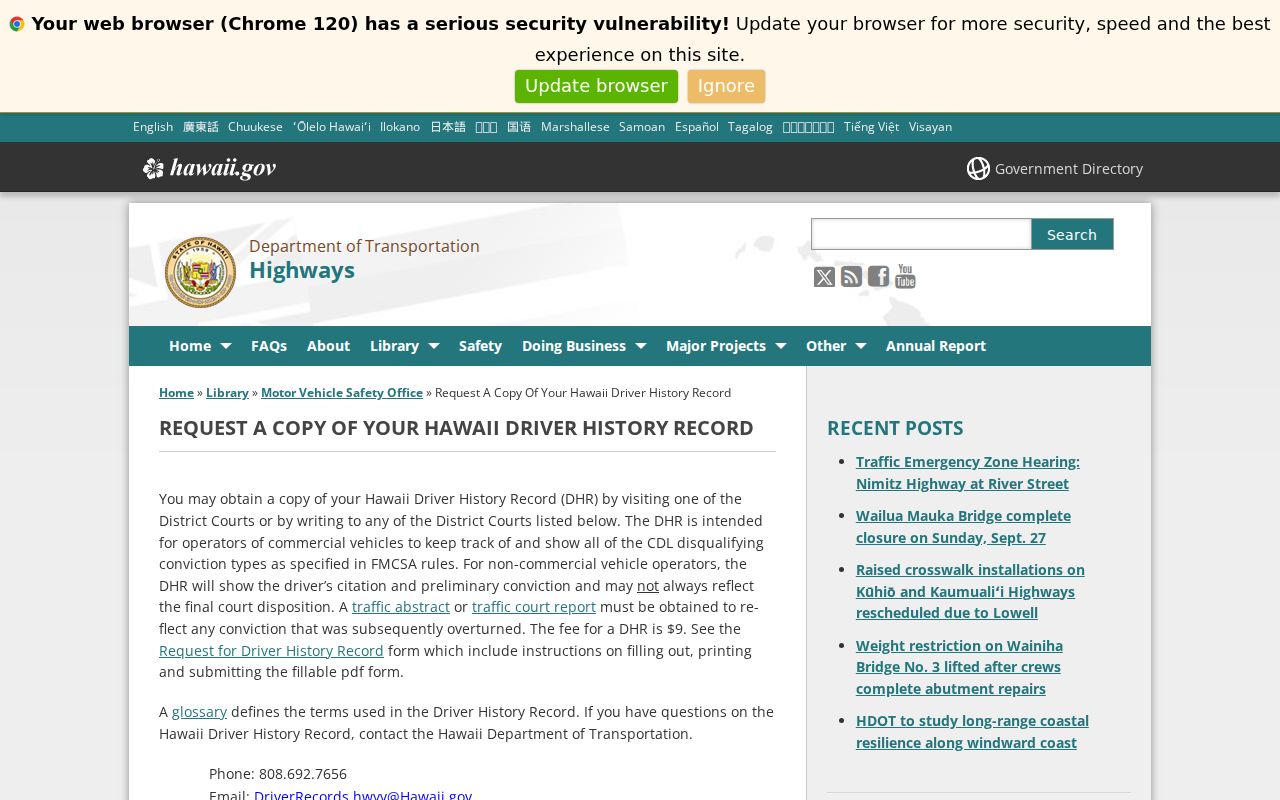
Need a Hawaii court disposition or abstract? Contact the Judiciary. A driver pulls their own state history from HDOT instead. Keep the two straight: eCourt Kōkua is not an official traffic abstract, and an HDOT history is not the court’s docket sheet.
Hawaii Traffic Citation Text Scams
In March 2026, Hawaii HDOT warned the public about scam texts demanding traffic fines or tolls. Real citations arrive by mail, never by text. HDOT’s official ticket-scam warning has the details.
Pay through the Hawaii Judiciary portal or the instructions printed on your citation. Never use an unsolicited payment link. If a Hawaii case does not show up in the index, call the court named on the notice. When a message claims a ticket is due, trust a mailed citation or the court record, not the text.